Sunday, March 19, 2017

Pholdable Phones in the Phuture

Phones may just be the most interacted with piece of technology people use in their daily lives. A constant problem with phones has been a tradeoff between size and portability. A big screen means more room to interact with whatever is there, but it also means more phone will be stuck in your pocket. A group of students at the University of British Columbia hopes to end this needless debate between screen size and portability. They have developed a new touch sensor that can be folded. Touchscreens have been through many changes since they were invented. The first "touchscreens" were regular displays surrounded by light emitters of some kind and sensors across from them. These lights would make a grid above the screen. When the screen was touched, a computer would figure out the coordinates of where the touch came, and what the corresponding point below the touch was supposed to represent. These systems were large, and not very practical for portability, but did make cool home automation systems.

Another widely used technology in the earlier days of portable touchscreens was resistive touch. This is when two pieces of film are places around a grid of materials with a current flowing through them. When the user presses down on the top layer of film the current flows through and registers an input. This type of screen is hard to use, not very precise, and generally low quality. However, it helped touchscreens to become portable.

Now we're onto current touchscreens and what the students at UBC have improved upon. Capacitive screens use your body as a conductor to complete a flow of electricity. This electric input tells the phone where you're touching. This is why most phone touchscreens can't be used with anything but a human input. The UBC students used a layered piece of plastic, made with silicone and a conductive gel, that can be folded. The material can also be stretched. What does this mean going forward? The students at UBC hope to implement it in ways more fulfilling than phones. It can be used across rooms, or even on medical devices that people can interact with on their own bodies. The best part of this new technology is its low cost. The last step to design what the students want, and even the whole bendable phone thing, is to create displays and other components that are compatible with the extreme shape shifting ability of UBC's new sensor.


https://www.sciencedaily.com/releases/2017/03/170315140704.htm

Virtual Reality Safety Training

Mollie Maggiacomo
.1 Engineering- Period A
3/19/2017


Virtual Reality Training for 'safe-critical' Jobs


In a recent article posted on, ScienceDaily.com, a group of researchers from the University of Exeter have developed a new training and technology organization called Cineon Training. The organization is an engineering a 360-degree training program through the use of virtual reality in order to "prevent accidents and improve the performance of workers." 


"The technology and methods that we use allow us to simulate stressful, high-risk environments, using mobile head-mounted simulators," said Dr Sam Vine, of the University of Exeter.

Cineon Training is also using the program for eye and psychological monitoring to study how people learn and how they are making errors. Cineon is holding a workshop on April 27th for trainers and safety experts in the nuclear industry (the group's main focus). The team hopes to use technology, scientific theory and measurement techniques in order to improve the performance of workers as well as provide feedback to trainers. For the past decade, the team has also been doing research into stimulated training for surgical, military and aviation settings. They believe that being able to train through a high-pressure computer animated program available in the trainee's headset will prove to be high- reward. The project, funded by a grant from the Economic and Social Research Council, will help to offer extremely needed training for all workers in the nuclear industry, especially those who will be working at forthcoming power plants. 

"Combined with our understanding of the psychology of learning and performing under pressure, we believe this to be a highly effective way to learn and perfect skills."


Surface Finishing for 3-D Printing

Surface Finishing for 3-D Printing 

Researchers have recently discovered a new process to improve the print quality of 3-D Printing. Prior to this knowledge, there were ways of smoothing 3-D printed items, but were higher in cost and less complex than this new discovery.
     Kensuke Takagishi as well as Professor Shinjiro Umeza chose the FDM type 3D printer (Fused deposition Modeling) whose relatively low cost makes it most practical for in-home usage. Some methods for smoothing are already available, one is simply polishing or grinding down the higher places to lower the appearance of "ribs." The downside about polishing or grinding is that, it is more complex and makes the machine cost more money, as well as the dust that is produced from the process makes the machine impractical for household usage.
       
      Vaporizing solvents to melt and smooth the surface of the printed piece is also used as a form of smoothing. This has the advantage of getting some of the dissolved material in the bottom of the grooves to increase the surface as well with less wasted resin. However complexity of the machine, indiscriminate dissolution of the entire surface, and handling of large amounts of flammable solvents are major issues to this method of surface finishing.

Kensuke Takagishi and Professor Shinjiro Umeza developed and tested a method called 3D Chemical Melting Finishing (3D-CMF). This uses a tool like a felt-tip pen to selectively apply solvent to certain parts of the printed piece. This method has huge advantages over the other methods of smoothing, they promise to move 3D printing into a much more attractive commercial position. 3D-CMF removes less material, creating less waste and achieving more precise shaping, and uses less solvent for better safety and lower cost. IN addition, the pen tips can be changed to further increase surface shaping precision.

The future is hear, like, for real.

Can you imagine, having your phone on you?


I mean physically
on your body.

Like, your phone is stuck to, say, your wrist. 

wrist phone

      ~~~~~PEOPLE HAVE FIGURED OUT A WAY TO DO THAT~~~~~      

Scientists at University Saarland have developed a sticker/sensor method to complete this task. (Shown below) 

   
     Now, their design is just the beginning of this endeavor, in other words its in a primitive state. They're already talking about how they could make it wireless, make it able to send messages, make it smaller, compact, user designed, etc. It looks a bit odd currently, like a bunch of lines on her arm, but it works! Its connected to a computer, and subsequently the internet, by a wire right now, but they are working on ways to make it  wireless, bluetooth or otherwise. 

What this means for the people:
To us right now, not much. So what, they're developing a way to put your phone on your wrist, I like mine in my hand. Sure, that's a viable argument, but if they continue to develop it in the way that they are, and it becomes popular and seen by society as 'cool' or 'chic' like the smart watches did, "iSkin", as they're calling it, will become the new big thing, and we're all going to end up having them. It's going to become the norm for people to have phones attached to their bodies, and the future will be upon us. 

 and it is here to stay.

https://www.sciencedaily.com/releases/2015/03/150304075218.htm


Blog #5: Reverse Engineering in Cybersecurity

Reverse Engineering in Cybersecurity

Though Reverse engineering is rather common in all fields of engineering, most of what I know about it is in Computer Security Engineering and Network Security, because it's a field that I happen to have a great deal of interest in.

What is Reverse Engineering?

Reverse engineering, in the field of computer security, is a rather important concept. It is applying the engineering mindset of understanding how something works, and building exploits or tools to work around it. In the field of cyber security, one may be tasked with reverse engineering something like a virus, and understanding the code behind it and how it works on a system. What changes does it make? What triggers it? What does each line of code do? People who reverse engineer are seeking to understand why something does or doesn't work, and what they can do to make it work in their own way. 
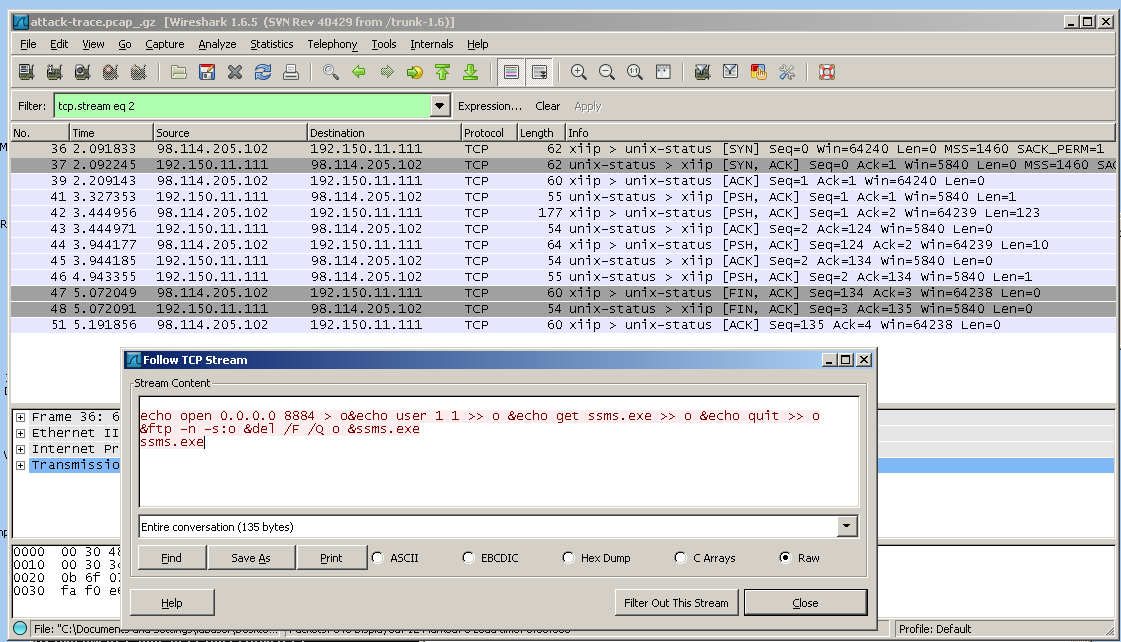
Image result for reverse engineering malware
Those who reverse engineer malware will frequently use this tool, wireshark, in order to view virus's network activity

If I were to have the desire to reverse engineer, say, an anti-piracy system for a piece of software, and develop a "crack" for it (which is illegal, don't do it), I would need to understand what makes a valid version of that software work. Are there certain files that tell the program that a user has the legal right to use it? Are there specific statements or conditions in the software's code that some how verifies that you paid for it? How can you trick the program into thinking someone has the paid version, even if they don't?

Image result for dirty cow linux diagram
"Dirty Cow" allowed for the tainting of a file, which spread to the rest of a system
Reverse engineering for cyber security is very similar. In fact, many exploits have been found, and fixed, thanks to reverse engineers. This is one of the reason why some software developers decide to go "open-source" and allow the general public to view the code that makes up their software. It allows for users to try and reverse engineer their products in attempts to find potential flaws and security concerns that can then be patched and fixed so that they cannot damage other users. It was because of this that the infamous "Dirty Cow" exploit was found and fixed, which was an exploit to the Linux Kernel. This allowed for an attacker to gain "root" access of a Linux system, thus gaining total and complete control of the system. Because the code for Linux was open source, the exploit was eventual found by a team of reverse engineers, and fixed in a series of updates that came to the Linux Kernel. Those who reverse engineer can use their power for good or evil, and are ultimately one of the reasons why we have hackers (of both good and bad nature) today.


http://puu.sh/uQ7Xo/bc69ac4fa4.png
It pays to be a reverse engineer for Google!
In addition to probing lines of code, reverse engineering also includes a lot of "hands on" testing. The first thing that reverse engineers think when using something is "how can I break this?". Some companies, such as Google, encourage users to try and reverse engineer their products in safe, responsible ways and report their security concerns to Google. When one finds a security concern and is able to successfully prove that it is a problem, the issue can be reported to Google. Often times, serious vulnerabilities will result in a reward from Google, which is called a "Bug Bounty". Those who find bugs can receive awards of 100-20,000 dollars, or higher if the vulnerability is especially dangerous.

A perfect example of reverse engineering was in the early days of graphical PC gaming, in which developers were gaining access to better graphics and higher quality images for video games. The problem was, user's aging hardware could not always support these advancements in technology. It seemed like the only solution for a while was to keep buying better parts. That was, until, "overclocking" became more popular. This is when one uses a piece of software to force hardware to run a bit faster than factory intended. This was originally developed by the company "AMD" in 1983. As one can imagine, computers in 1983 were quite slow, so anything that could make them faster was a welcomed change. Though it was possible in 1983, it didn't really become popular until 10 years ago or so, as gaming became more popular. The act of reverse engineering early computers gave us overclocking, which eventually, lead to faster computers and the overall digitization of the modern world.

Reverse engineering, like most forms of engineering, can be used for good or evil. Some reverse engineers will go on to develop "cracks" for expensive software, so that they can use it for free. Others, will go on to find flaws in the systems of Google, and help make the internet a more secure place. Some will go on to do both. However, whatever one may chose, it is important to realize that reverse engineering, especially in the fields of Computer Science and cyber security, is a fundamental aspect of the science, and without it, we would not have many of the innovations that we have today, such as anti-virus programs and faster computers. Reverse engineers push the envelop, even when others believe that there is nothing else to do.


Saturday, March 18, 2017

Logan Liljeberg Blog #5- MRI-powered mini robots

Saturday, March 18th, 2017
Logan Liljeberg


MRI-powered mini robots

For my first blog post of the quarter, I found a recent engineering idea from the University of Houston.  It looked very interesting and I decided to look more into the topic on ScienceDaily.com.  The invention Aaron Becker and his team are trying to create are MRI-powered mini robots that can deliver drugs and other medical treatments non-invasively, as well as speed up the information from MRI scans. They are trying create robots that are millimeters in size, so they can travel in the venous system of the human body and deliver drugs/treatment.  

The reasons the University of Houston is researching this topic is because of the complications and slow healing process for patients, as well as the time lag of getting information back from the scans. The surgical techniques like cutting through the breastbone for open heart surgery or making a large incision to inspect an abdominal tumor work well, but have a slow healing process.  This is where the MRI robots come into play.  The scientists want to deploy thousands of these mini robots so they can deliver the drugs or self-assemble interventional tools.  The traditional MRI has been used for noninvasive diagnosis and can have time lags before the information is available.  By deploying these mini robots, the MRI process can be sped up and help to deliver drugs and other medical treatments 

To carry out this idea, the researchers have developed control algorithms, imaging technology, ultrafast computational methods and human-machine immersion methods.  These factors help to harness the force from a magnetic resonance imaging (MRI) scanner to both image and then steer the millimeter-sized robots through the body.  They are trying to take this idea that is seen as science fiction and turn it into reality.  They are trying to get the robots to be me .5 millimeters, so they can easily travel through the venous system.  They are trying to use the magnetic force from the MRI machines, along with the technology they created to control the mini robots.  One of the designs they are working on is self assembling surgical tool called a Gauss gun, which is used for tissue penetration.  The ultimate goal is steer large numbers of robots throughout the body.  One milli-robot could target a single lesion, but large numbers could deliver chemotherapy or another treatment that isn't practical.  

Below is a video of the MRI-powered Gauss gun tissue penetration

This video shows the technique for generating large impulsive forces to penetrate tissues.  It engages in the tissue and then fires its needle into it.  It goes from the trigger, to the barrel, and then to the delivery of the needle.  It fires from using potential and kinetic energy from the MRI machine.


Here is a picture of the break down of how the gun fires...  


Overall, this was a really cool article and I found it very interesting.  I hope the researchers at the University of Houston are able to make this into a real thing because it can be very beneficial for patients in the future.  To think that tiny robots powered by a MRI machine can travel our venous system and give a faster and more accurate report is amazing.  They can also help with minimal invasive treatment in the tissue and they hope to be able to power large numbers that can help with chemotherapy.  This invention is awesome and I hope it works out because it could be the next big medical breakthrough.        

Website that I used:

Friday, January 13, 2017

Honda at CES


Recently at the CES, Honda unveiled a list of new “mobility systems”. These systems include a new AI technology, a new personal electric vehicle concept, and self balancing motorcycle

Honda calls this motorcycle the Riding Assist Motorcycle. The self balancing system is different from previous systems because the type of technology it utilizes. It is engineered to feel more like a traditional motorcycle riding experience. This was an improvement over a bike equipped with gyros was heavy and handled poorly. The new system stabilizes the bike by making small steering inputs and adjusting lean in the direction of travel.  Honda utilized technology from their UNI-CUB , which operates similar to a segway.


Honda also unveiled an electric vehicle concept based off what they believe the future of vehicles will be.The concept is called the Neu-V, New electric urban vehicle. It is designed to be a small personal mobility vehicle for urban environments. I thought this was an interesting vision of the future. I think it's a great concept to maximize the use of the car and also earn money with it when it's not in use and provide clean transportation for those who need it. According to Honda a vehicle sits idle for 96% of its lifetime. Part of their design is to maximize this time to make money for the owner. The vehicle would act like an autonomous taxi system.


I thought the Self balancing motorcycle that handled was the most interesting concept, until I heard that the main focus of the Neu-V was the Honda Automated Network Assistant. The system


It basically turns your car's AI into your mom. The car will identify and catalogue your decisions and emotions, then tell you what to do to improve your driving. I see how it could be an interesting concept. However I find it goofy.

The vehicle itself is a small two door compact. The vehicle will be powered buy a 55kw motor and plans to have a range between 100 and 200 miles which is more than sufficient for an urban environment.
http://www.motortrend.com/news/honda-debuts-ev-concept-self-balancing-motorcycle-at-ces/