Tuesday, May 2, 2017

Waste Glass Bottles Turned to Batteries


The future of batteries involves the use of waste glass bottles.  Using these bottles and a low-cost chemical process, researchers at the University of California Riverside's Bourns College of Engineering have created nanosilicon anodes for high-performance lithium-ion batteries.  These batteries will be used to significantly extend the range of electric and hybrid plug-in cars and will enable their charge to last longer.  This upgrade will also be applied to personal devices including computers, smartphones, and tablets.

Image result for batteriesImage result for waste glass bottles

The project is headed by Cengiz Ozkan, a professor of mechanical engineering, and Mihri Ozkan, a professor of electrical engineering.  The two professors published their work in the nature journal Scientific Reports in an article titled "Silicon Derived from Glass Bottles as Anode Materials for Lithium Ion Full Cell Batteries".
Cengiz Ozkan


The science behind the idea:  
"Silicon anodes can store up to 10 times more energy than conventional graphite anodes, but expansion and shrinkage during charge and discharge make them unstable. Downsizing silicon to the nanoscale has been shown to reduce this problem, and by combining an abundant and relatively pure form of silicon dioxide and a low-cost chemical reaction, the researchers created lithium-ion half-cell batteries that store almost four times more energy than conventional graphite anodes."

Silicon dioxide, which is found in the millions of waste beverage bottles that end up in landfills every year, is believed to have the capabilities of providing high purity silicon nanoparticles for lithium-ion batteries.  Once the bottles are obtained, they are ground into a fine, white powder.  Then the silicon dioxide is transformed into nanostructured silicon and coated with carbon to improve stability and energy storage properties.  These carbon-coated glass derived-silicon batteries proved to be stronger and more efficient than traditional batteries in laboratory tests conducted by the UCR researchers.  The manufacturing of the batteries is also efficient, as one glass bottle provides enough nanosilicon for hundreds of these batteries.

The batteries are known as coin cell batteries.  

Related image

"We started with a waste product that was headed for the landfill and created batteries that stored more energy, charged faster, and were more stable than commercial coin cell batteries. Hence, we have very promising candidates for next-generation lithium-ion batteries," said Changling Li, a graduate student in materials science and engineering at UCR and the lead author on the paper publishing the Ozkans' findings.

3D Printing Glass!


Carly Pereira

3D Printing Complex Glass Structures is now Possible


     A team at the KIT led by mechanical engineer Dr. Bastian E. Rapp developed a process using glass

for additive manufacturing techniques. The scientists mix nanoparticles of high-purity quartz glass and 

a small quantity of liquid polymer and allow this mixture to be cured by light at specific points – by 

means of stereolithography. The material, which has remained liquid, is washed out in a solvent bath,

leaving only the desired cured structure. The polymer still mixed in this glass structure is subsequently 

removed by heating. “The shape initially ... is still unstable, and therefore the glass is sintered in a final 

step, i.e. heated so that the glass particles are fused,” explains Rapp. 

     Where glass was previously processed into structures, for instance by melting and application by 

means of a nozzle, the surface turned out to be very rough, the material was full of holes and contained 

gaps. “We present a new method, an innovation in materials processing, in which the material of the 

piece manufactured is high-purity quartz glass with the respective chemical and physical properties,” 

explains Rapp. The glass structures made by the KIT scientists show resolutions in the range of a few 

micrometers – one micrometer corresponding to one thousandth of a millimeter. However, the structures 

may have dimensions in the range of a few centimeters, emphasizes Rapp. 

     Another application of this technology could be new, complex biomedical instruments and even 

laptops and cameras.   The work performed by the research group headed by Rapp has been funded by

the BMBF since 2014 for a total of four years to the tune of approx. € 2.8 million. “Our research benefits

very much from the interdisciplinary cooperation of various KIT institutes. Besides the Institute of 

Microstructure Technology, colleagues of the Institute of Nuclear Waste Management and the Institute of 

Applied Materials, among others, are involved in the project,” says Rapp.

Robotic cheetah created

University of Twente researcher Geert Folkertsma has developed a prototype cheetah robot. Folkertsma has dedicated four years of research and development to constructing a scaled-down robotic version of the fastest land animal in the world, with a view to replicating its movements. Relatively speaking, the robot moves using only about fifteen percent more ene
rgy than a real cheetah. Folkertsma's doctoral defence of this unique project will take place on 21 April 2017 at the University of Twente.
"As you might expect of the fastest land animal in the world, the cheetah makes very efficient use of its energy," Folkertsma explains. "I wanted to create a robot that runs the same way, with the aim of applying this knowledge to the development of new robots. Robots are bound to play an increasingly important part in our daily lives and we therefore have to ensure that they can move effectively in our environment. My robot vacuum cleaner, for example, cannot climb stairs or even cope with thresholds. We therefore need to develop robots that can walk and when it comes to moving around efficiently, there's a lot we can learn from the cheetah."
While walking robots tend to be large and heavy, taking cumbersome steps that use a lot of energy, the cheetah runs swiftly and smoothly. "By applying knowledge about the movement patterns of the cheetah, you can develop robots that walk more elegantly and above all efficiently," Folkertsma continues. His research provides valuable knowledge that can be used to optimize the robots of the future, designed to support us in areas such as healthcare or housekeeping. The knowledge gained from the project can also be put to good use in rehabilitation robots or advanced prosthetics that are equipped with robotics.
Folkertsma studied extensive video footage of cheetahs and used software to analyse their movements. The backbone proves crucial to the power this big cat generates. Bending and extending its spine enables the cheetah to move efficiently, run exceptionally fast and make huge leaps. "The main difference between existing walking robots and my cheetah robot is therefore the backbone," Folkertsma says. "The trick was to imitate it without complicating matters unnecessarily: instead of vertebrae and intervertebral discs, we worked with a cleverly placed spring which delivers approximately the same effect. Cheetahs are also able to store a lot of energy in their muscles for later use. This too is something we have imitated by fitting carefully selected springs in our robot's legs."
"My robot can be seen as a simulated skeleton, complete with muscles and joints. Not every element is where you would find it in the animal, but the spine, shoulders and hips occupy the same position. A real cheetah not only runs, but also climbs trees for example. That is not something our robot needs to copy. After all, the aim was not to reconstruct a cheetah, but to reap the rewards of its efficient way of running. By way of illustration, the robot does not have a normal foot, but a light-weight mechanism with springs which turned out to be more efficient."
The prototype developed by Folkertsma weighs in at 2.5 kg and is 30 cm long: twenty times lighter than a real cheetah and four times smaller. Taking into account the weight difference, the robot moves using only about fifteen percent more energy than a real cheetah. The robot can currently reach a speed of about one kilometre per hour. "That's quite a pace for such a small robot," Folkertsma observes. "More research is needed to enable it to run as fast as a real cheetah, relatively speaking. That would entail getting up to a speed of around twenty kilometres per hour. A Master's student is currently working on a newly developed robotic leg and the first tests, focusing on a single leg, are already promising. With four legs of this type, the robot will be able to run much faster; I think this will help us make genuine advances."
Geert Folkertsma will defend his PhD thesis entitled Energy-based and biomimetic robotics in the Prof. G. Berkhoff hall, in the Waaier Building on the University of Twente campus at 16.45 on 21 April. He conducted his doctoral research at the Department of Robotics and Mechatronics (RAM), under the supervision of Prof. Stefano Stramigioli.

US Navy creates zinc-based rechargeable lithium battery alternative.

Throughout the recent years, there is an expectation that a new rechargeable battery would emerge to replace the old standard lithium ion batter. Known for its potential dangers of exploding- as seen recently with the Samsung Note 7- the lithium ion batter is clearly not a permanent solution for the problem of portable recharging. Currently there is one group that plans on revolutionizing this field forever: the United States Navy.

The US Navy has recently unveiled the newest invention on the field of portable batteries, a zinc based battery alternative that shows clear safety and energy improvements. 

"We can now offer an energy-relevant alternative, from drop-in replacements for lithium-ion to new opportunities in portable and wearable power," said Dr. Jeffrey Long, a member of the NRL's Advanced Electrochemical Materials group.


This improvement can be obvious for not only those who serve at seas, but also for those here at home who wish to increase battery life and safety. 

The reason this research began was due to an explosion on a navy ship in '08 at Pearl Harbor. No one was injured in the blast, but this was one of the main concerns for the need of a better alternative.


3-D Printed Building

3-D Printing an Entire Building
The list of materials that can be 3-D printed has come to now include metal, glass and actually even food, not just plastics. MIT researchers are now expanding this list by designing a system that can print the entire structure of a building.
By printing the basic structure, the structures could be built faster along with cheaper. 
A building could also be completely customized to the needs of a particular site and the desires of its maker. Even the internal structure could be modified in new ways; different materials could be incorporated as the process goes along, and material density could be varied to provide optimum combinations of strength, insulation, or other properties.
Ultimately, the researchers say, this approach could enable the design and construction of new kinds of buildings that would not be feasible with traditional building methods.
The robotic system is described this week in the journal Science Robotics, in a paper by Steven Keating PhD '16, a mechanical engineering graduate and former research affiliate in the Mediated Matter group at the MIT Media Lab; Julian Leland and Levi Cai, both research assistants in the Mediated Matter group; and Neri Oxman, group director and associate professor of media arts and sciences.
The system consists of a tracked vehicle that carries a large, industrial robotic arm, which has a smaller, precision-motion robotic arm at its end. This highly controllable arm can then be used to direct any conventional (or unconventional) construction nozzle, such as those used for pouring concrete or spraying insulation material, as well as additional digital fabrication end effectors, such as a milling head.
Ultimately, the system is intended to be self-sufficient. It is equipped with a scoop that could be used to both prepare the building surface and acquire local materials, such as dirt for a rammed-earth building, for the construction itself. The whole system could be operated electrically, even powered by solar panels.
"The construction industry is still mostly doing things the way it has for hundreds of years," says Keating. "The buildings are rectilinear, mostly built from single materials, put together with saws and nails," and mostly built from standardized plans.
But, Keating wondered, what if every building could be individualized and designed using on-site environmental data? In the future, the supporting pillars of such a building could be placed in optimal locations based on ground-penetrating radar analysis of the site, and walls could have varying thickness depending on their orientation. For example, a building could have thicker, more insulated walls on its north side in cold climates, or walls that taper from bottom to top as their load-bearing requirements decrease, or curves that help the structure withstand winds.
The creation of this system, which the researchers call a Digital Construction Platform (DCP), was motivated by the Mediated Matter group's overall vision of designing buildings without parts. Such a vision includes, for example, combining "structure and skin," and beams and windows, in a single production process, and adapting multiple design and construction processes on the fly, as the structure is being built.
From an architectural perspective, Oxman says, the project "challenges traditional building typologies such as walls, floors, or windows, and proposes that a single system could be fabricated using the DCP that can vary its properties continuously to create wall-like elements that continuously fuse into windows."
To this end, the nozzles of the new 3-D printing system can be adapted to vary the density of the material being poured, and even to mix different materials as it goes along. In the version used in the initial tests, the device created an insulating foam shell that would be left in place after the concrete is poured; interior and exterior finish materials could be applied directly to that foam surface.

Monday, May 1, 2017

Logan Liljeberg Blog #6- Iron Man Suit

Monday, May 1st, 2017
Logan Liljeberg
Iron Man Suit

For my first blog of the 4th quarter I found a very interesting article from Phys.org.  The article had to do with an engineer and athlete who created an Iron Man like Suit.  The man who created this suit was a British inventor by the name of Richard Browning.  On Thursday Browning lifted off the shore of Vancouver Harbor, which was inspired by the comic superhero Iron Man.  The suit is only able to lift him a couple feet off the ground right now, but it is remarkable how he has accomplished this much.  Browning recently attended at TED talk in the suit to show off how it works to the crowd.    


The Iron Man like suit is made up of a small jet engines attached on Brownings arms, back and legs. There are 3 engines on each of his arms and then 1 on each leg that he wears, and each have 22 Kilograms off thrust.  When they are all put together they are able to lift him off the ground and let him hover.  This may not seem like a lot to people, but to get him a couple feet off the ground and hover took months of work.  Even though he can't fly around like Iron Man, he is making strides in the right direction to get there.  The suit is able to propel wearers much higher and faster, than an average people jumping.  


The end goal of this project is to one day have a full flight suit that will allow its wearers to soar across the sky.  He has had a dream and is fulfilling that with his flying suit.  It was his dad who got him into flying machines, but he passed away when he was a teenager.  Browning has carried out that love from both his father and his personal self by creating this Iron Man like suit.  Browning has seen Iron Man and the suit he wears and stresses to his viewers that his goal is firmly rooted in the real world.  This means he wants to create this suit for the love of flying and that one day can be used to get from point A to point B much easier.  

Below is a video on Browning explaining the Iron Man like Suit and then using it.


This video gives a great look into how Browning has designed the suit and how it has come to the flying stage.  A huge part of building the suit has been being able to rapidly prototype things and find parts online.  When finding things online they are usually on the workbench the next day so he can get to building and making head way on the suit.  Browning has said he is already getting interest from investors and some in the British military who told him they had given up on the flight feature of an 'Iron Man' suit until seeing his human-propulsion gear.  His work and 55 second video have touched so many people and given them hope on this feat that we have deemed impossible.  

Below is another video of the testing of the actual suit

This is a different video from Browning and this one shows his progress through the creation of the Iron Man Suit.  It is awesome to see all the hard work and dedication he has put in just to make this work.  He has a job and a family, yet still finds time to work on this project.  He tested the arm engineers, harnessed himself into a sling and tested it so he would not fall, and best of all does calisthenics for core strength which looks crazy.  Browning is dedicated to this craft and his hard work has definitely paid off for sure.  It is not over yet, but he is on his way to creating something magical for sure!     
 
Overall, this was the best article I found on an engineering idea for all 4 quarters.  The title hooked me right away and I knew this was going to be something very interesting and it was.  I hope Browning keeps up his hard work because he has come so far and has to finish this project.  It is showing people that a flying jet pack machine is possible!  How cool would it be if we could strap this thing on and go fly around to get somewhere.  I think this is where our world is headed and I am not complaining.  This invention is very cool and I hope it works out for Browning and his team!  

Website and article:


Kyle Emond
Engineering Period A
4/1/17

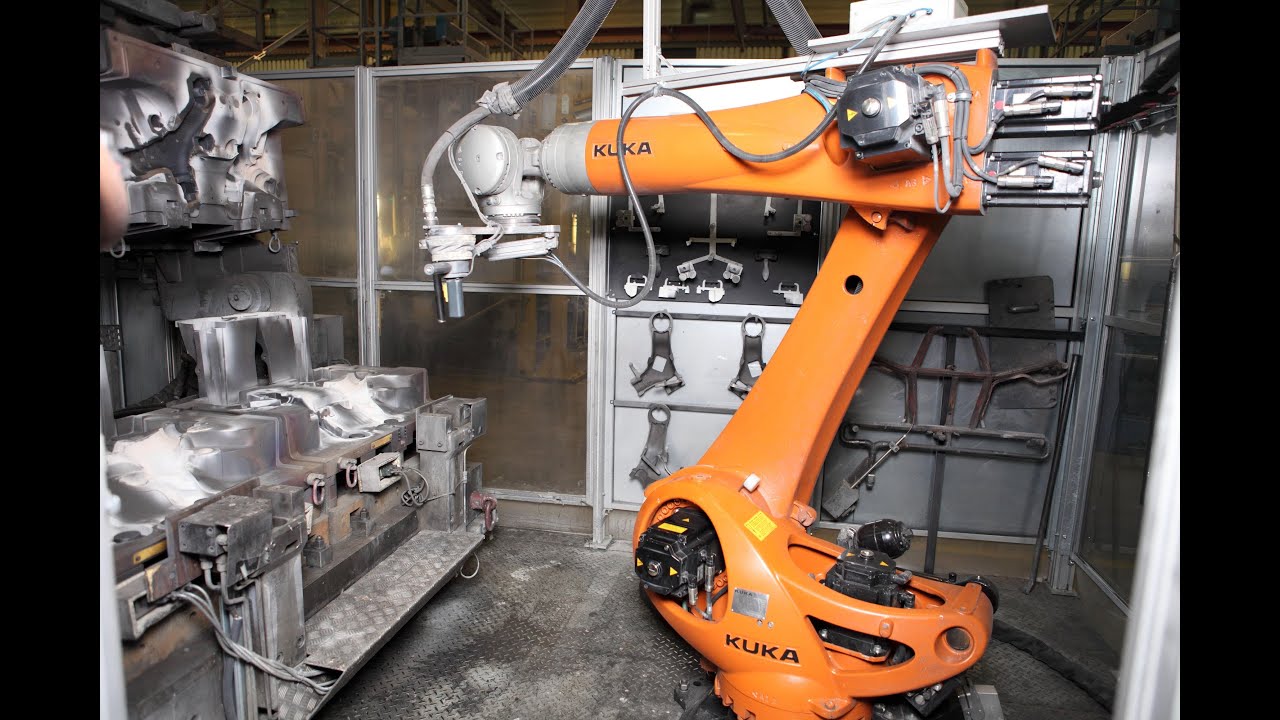
The image above shows robots in a Tesla factory working on building a car by putting together a variety of parts. They cost anywhere between 50k and 500k. Main operations include switching adapters and moving across multiple axes. One person from the faculty has said, "'There are Kuka robots all over the place waiting to be installed. It's a beautiful thing." This brings into question how much jobs are being lost at Tesla? It also raises eyebrows to the fact other companies are catching on to this trend, both tech companies, as well as non-tech companies. 

These Kuka robots in the Tesla factory are quite impressive. 

This is the right arm of the Kuka robot. It can insert screws to others giant arms capable of lifting an entire block. It works with dozens of major motor manufacturers to automate their production lines. It's heavy duty version, called the KR 1000 titan, is 'the first six-axis robot with an open kinematic system and an unparalleled payload capacity.' KUKA offers a range of different arms, from small units for delicate work to its TITAN that is capable of picking up and entire car. It can handle heavy loads over distances of up to 6.5 meters, carrying engine blocks, stones, glass, steel beams, components for ships and aircraft, marble blocks, and even precast concrete parts.

Elon Musks says, "You can't have people in the production line itself, otherwise you drop to people speed. So there will be no people in production process itself." The robots are speeding up production and instead of an assembly line of people, there is an assembly line of robots/ machines. Although, it seems many jobs are lost because of this technology, some do exist. Tesla still has employees working in the factory, though, mostly overseeing the robots and making sure everything is running at peak efficiency. So, instead of doing the work themselves, they overlook robots doing the work. 

Getting back to my original question of how many jobs are lost because of the rise of tech in recent years. I do think Tesla has provided many jobs, as it has became a large player in the automative space in recent years, but it is contributing to the tech environment that we now live in. So, other companies are adapting the technology to catch up to their speeds of production and this is ultimately adding up to thousands of lost jobs here in the US.