Tuesday, May 2, 2017

US Navy creates zinc-based rechargeable lithium battery alternative.

Throughout the recent years, there is an expectation that a new rechargeable battery would emerge to replace the old standard lithium ion batter. Known for its potential dangers of exploding- as seen recently with the Samsung Note 7- the lithium ion batter is clearly not a permanent solution for the problem of portable recharging. Currently there is one group that plans on revolutionizing this field forever: the United States Navy.

The US Navy has recently unveiled the newest invention on the field of portable batteries, a zinc based battery alternative that shows clear safety and energy improvements. 

"We can now offer an energy-relevant alternative, from drop-in replacements for lithium-ion to new opportunities in portable and wearable power," said Dr. Jeffrey Long, a member of the NRL's Advanced Electrochemical Materials group.


This improvement can be obvious for not only those who serve at seas, but also for those here at home who wish to increase battery life and safety. 

The reason this research began was due to an explosion on a navy ship in '08 at Pearl Harbor. No one was injured in the blast, but this was one of the main concerns for the need of a better alternative.


3-D Printed Building

3-D Printing an Entire Building
The list of materials that can be 3-D printed has come to now include metal, glass and actually even food, not just plastics. MIT researchers are now expanding this list by designing a system that can print the entire structure of a building.
By printing the basic structure, the structures could be built faster along with cheaper. 
A building could also be completely customized to the needs of a particular site and the desires of its maker. Even the internal structure could be modified in new ways; different materials could be incorporated as the process goes along, and material density could be varied to provide optimum combinations of strength, insulation, or other properties.
Ultimately, the researchers say, this approach could enable the design and construction of new kinds of buildings that would not be feasible with traditional building methods.
The robotic system is described this week in the journal Science Robotics, in a paper by Steven Keating PhD '16, a mechanical engineering graduate and former research affiliate in the Mediated Matter group at the MIT Media Lab; Julian Leland and Levi Cai, both research assistants in the Mediated Matter group; and Neri Oxman, group director and associate professor of media arts and sciences.
The system consists of a tracked vehicle that carries a large, industrial robotic arm, which has a smaller, precision-motion robotic arm at its end. This highly controllable arm can then be used to direct any conventional (or unconventional) construction nozzle, such as those used for pouring concrete or spraying insulation material, as well as additional digital fabrication end effectors, such as a milling head.
Ultimately, the system is intended to be self-sufficient. It is equipped with a scoop that could be used to both prepare the building surface and acquire local materials, such as dirt for a rammed-earth building, for the construction itself. The whole system could be operated electrically, even powered by solar panels.
"The construction industry is still mostly doing things the way it has for hundreds of years," says Keating. "The buildings are rectilinear, mostly built from single materials, put together with saws and nails," and mostly built from standardized plans.
But, Keating wondered, what if every building could be individualized and designed using on-site environmental data? In the future, the supporting pillars of such a building could be placed in optimal locations based on ground-penetrating radar analysis of the site, and walls could have varying thickness depending on their orientation. For example, a building could have thicker, more insulated walls on its north side in cold climates, or walls that taper from bottom to top as their load-bearing requirements decrease, or curves that help the structure withstand winds.
The creation of this system, which the researchers call a Digital Construction Platform (DCP), was motivated by the Mediated Matter group's overall vision of designing buildings without parts. Such a vision includes, for example, combining "structure and skin," and beams and windows, in a single production process, and adapting multiple design and construction processes on the fly, as the structure is being built.
From an architectural perspective, Oxman says, the project "challenges traditional building typologies such as walls, floors, or windows, and proposes that a single system could be fabricated using the DCP that can vary its properties continuously to create wall-like elements that continuously fuse into windows."
To this end, the nozzles of the new 3-D printing system can be adapted to vary the density of the material being poured, and even to mix different materials as it goes along. In the version used in the initial tests, the device created an insulating foam shell that would be left in place after the concrete is poured; interior and exterior finish materials could be applied directly to that foam surface.

Monday, May 1, 2017

Logan Liljeberg Blog #6- Iron Man Suit

Monday, May 1st, 2017
Logan Liljeberg
Iron Man Suit

For my first blog of the 4th quarter I found a very interesting article from Phys.org.  The article had to do with an engineer and athlete who created an Iron Man like Suit.  The man who created this suit was a British inventor by the name of Richard Browning.  On Thursday Browning lifted off the shore of Vancouver Harbor, which was inspired by the comic superhero Iron Man.  The suit is only able to lift him a couple feet off the ground right now, but it is remarkable how he has accomplished this much.  Browning recently attended at TED talk in the suit to show off how it works to the crowd.    


The Iron Man like suit is made up of a small jet engines attached on Brownings arms, back and legs. There are 3 engines on each of his arms and then 1 on each leg that he wears, and each have 22 Kilograms off thrust.  When they are all put together they are able to lift him off the ground and let him hover.  This may not seem like a lot to people, but to get him a couple feet off the ground and hover took months of work.  Even though he can't fly around like Iron Man, he is making strides in the right direction to get there.  The suit is able to propel wearers much higher and faster, than an average people jumping.  


The end goal of this project is to one day have a full flight suit that will allow its wearers to soar across the sky.  He has had a dream and is fulfilling that with his flying suit.  It was his dad who got him into flying machines, but he passed away when he was a teenager.  Browning has carried out that love from both his father and his personal self by creating this Iron Man like suit.  Browning has seen Iron Man and the suit he wears and stresses to his viewers that his goal is firmly rooted in the real world.  This means he wants to create this suit for the love of flying and that one day can be used to get from point A to point B much easier.  

Below is a video on Browning explaining the Iron Man like Suit and then using it.


This video gives a great look into how Browning has designed the suit and how it has come to the flying stage.  A huge part of building the suit has been being able to rapidly prototype things and find parts online.  When finding things online they are usually on the workbench the next day so he can get to building and making head way on the suit.  Browning has said he is already getting interest from investors and some in the British military who told him they had given up on the flight feature of an 'Iron Man' suit until seeing his human-propulsion gear.  His work and 55 second video have touched so many people and given them hope on this feat that we have deemed impossible.  

Below is another video of the testing of the actual suit

This is a different video from Browning and this one shows his progress through the creation of the Iron Man Suit.  It is awesome to see all the hard work and dedication he has put in just to make this work.  He has a job and a family, yet still finds time to work on this project.  He tested the arm engineers, harnessed himself into a sling and tested it so he would not fall, and best of all does calisthenics for core strength which looks crazy.  Browning is dedicated to this craft and his hard work has definitely paid off for sure.  It is not over yet, but he is on his way to creating something magical for sure!     
 
Overall, this was the best article I found on an engineering idea for all 4 quarters.  The title hooked me right away and I knew this was going to be something very interesting and it was.  I hope Browning keeps up his hard work because he has come so far and has to finish this project.  It is showing people that a flying jet pack machine is possible!  How cool would it be if we could strap this thing on and go fly around to get somewhere.  I think this is where our world is headed and I am not complaining.  This invention is very cool and I hope it works out for Browning and his team!  

Website and article:


Kyle Emond
Engineering Period A
4/1/17

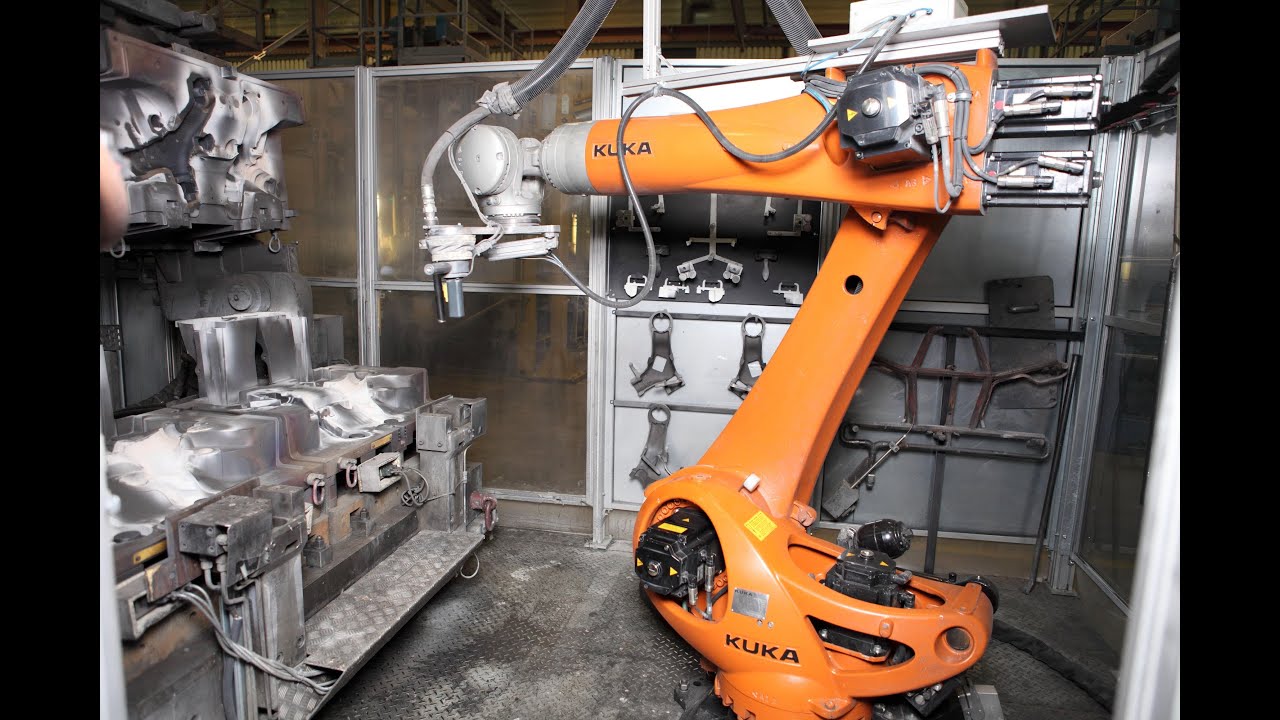
The image above shows robots in a Tesla factory working on building a car by putting together a variety of parts. They cost anywhere between 50k and 500k. Main operations include switching adapters and moving across multiple axes. One person from the faculty has said, "'There are Kuka robots all over the place waiting to be installed. It's a beautiful thing." This brings into question how much jobs are being lost at Tesla? It also raises eyebrows to the fact other companies are catching on to this trend, both tech companies, as well as non-tech companies. 

These Kuka robots in the Tesla factory are quite impressive. 

This is the right arm of the Kuka robot. It can insert screws to others giant arms capable of lifting an entire block. It works with dozens of major motor manufacturers to automate their production lines. It's heavy duty version, called the KR 1000 titan, is 'the first six-axis robot with an open kinematic system and an unparalleled payload capacity.' KUKA offers a range of different arms, from small units for delicate work to its TITAN that is capable of picking up and entire car. It can handle heavy loads over distances of up to 6.5 meters, carrying engine blocks, stones, glass, steel beams, components for ships and aircraft, marble blocks, and even precast concrete parts.

Elon Musks says, "You can't have people in the production line itself, otherwise you drop to people speed. So there will be no people in production process itself." The robots are speeding up production and instead of an assembly line of people, there is an assembly line of robots/ machines. Although, it seems many jobs are lost because of this technology, some do exist. Tesla still has employees working in the factory, though, mostly overseeing the robots and making sure everything is running at peak efficiency. So, instead of doing the work themselves, they overlook robots doing the work. 

Getting back to my original question of how many jobs are lost because of the rise of tech in recent years. I do think Tesla has provided many jobs, as it has became a large player in the automative space in recent years, but it is contributing to the tech environment that we now live in. So, other companies are adapting the technology to catch up to their speeds of production and this is ultimately adding up to thousands of lost jobs here in the US. 


Friday, April 28, 2017

Blog Post #6: Open Source Engineering


Christopher Iadeluca

Open Source Engineering

  From this course, I think we've all learned the importance of engineering in our every day lives. This is especially true from the modern world, which grows increasingly computerized. If you've read my other blog posts, you can probably tell that I really enjoy technology, especially when it is "open source". For those of you who have no read my previous blog posts, if something is open source, that means that it is open for the public to view, use and manipulate for free (so long as it within the bounds of the law). It gives users a sense of freedom, as they are in total control of whatever they use. Anyone can view the components that make it up, be it code, circuits or otherwise. 

Image result for open source
Open Source Software logo
There is a phrase that is repeated frequently in the world of open source geeks. It is; "free as in freedom, not free as in beer". This means that open source technology can be profitable. For example, there is a Chrome add on by the name of JSTorrent, which downloads torrent files in the Chrome Browser. On the Chrome Web store, it costs $2.99. However, you go to the GitHub page (A website in which programmers share their code and create open source software together) and view all of the code for free. You can even download a copy from there, and if you're tech savvy enough, you can avoid the $2.99. The point is, the developers gave you, the user, the option to either pay, or not. Therefore, you had the freedom of choice. And that's what it really comes down to; choice.


While open source often pertains to software, it can also pertain to hardware. The Arduino, for example, which we used earlier this year, is a perfect example of open source hardware. The Arduino, and all of its variants, have schematics that can be viewed online, for free. This means that if you wished to reconstruct it, you could, provided that you had the right parts. It is also programmed using software, which is also open source. This is compared to a piece of hardware that is "closed source". An example of closed source would be something like the Apple Macbook's, or any major laptop manufacturer for that matter. If you were to search online, you cannot find a single, legal way to view them. While you can find some of the schematics, they are not legally being hosted, and are not approved by Apple. This is the nature of closed source software. On the contrary, Arduino encourages people to view the Arudino schematics, so that they may innovate and create new versions of their existing product.


http://futurist.se/gldt/wp-content/uploads/subtrees/debian1007.png
Debian, an open source operating system, has gone on to spawn many other versions
Another crucial part of open soft engineering is people who "fork" the project. Forking is the act of taking the original project and creating a separate project, while using the original as a basis. While this would be considered Copyright Infringement by normal standards, it is encouraged within the open source community, because it allows for new innovations while utilizing existing technology. We use such technology every day. Our phones, for example, often use a "forked" version of the Linux Kernal, a piece of software that allows for software to interact with hardware. Because the Linux Kernal is open source, it allows for anyone to use it in their own creations. Everything from the Internet of Things to the phones in our pockets are a byproduct of open source engineering, and it is because of it that we are able to have such innovations.

Open source engineering applies to more than just computer's, though. Open source is a general term within engineering, and applies to nearly any form of engineering that encourages the open exchange of ideas and modifications. Though it is most common in computing, I believe it should be encouraged throughout all forms of engineering, as it allows for the advancement of technologies through community involvement. Simply put, open source engineering is what gives us so much of the technology that we rely on on a day to day basis. 

Wednesday, April 5, 2017

Engineering Blog


Honda Clarity is a hydrogen fuel cell vehicle

The goal was to make the vehicle drive as much like a traditional vehicle as possible, and according to the article, honda has accomplished this goal. A problem with fuel cell vehicles was their lack of throttle response. This gave drivers little confidence in situations like merging. The Honda Clarity's driving experience was equated that of a traditional electric hybrid vehicle.

Another problem with previous fuel cell vehicles was their sound and overall packaging. According to the review, Honda has rectified all of these issues. A further improvement was made in the system's airflow. There is a 70 percent greater pressure in the fuel cell.
The tank itself holds 10,000 psi of pressure and takes only 3-5 minutes to fill.


The estimation for combined fuel economy is  69 MPGe, based on their claim that 1 kg of hydrogen equating to a gallon of gasoline, then the estimation for the maximum range should be about 370 miles.  


Tuesday, April 4, 2017

Why Dragonfly Wings Kill Bacteria


Currently, surfaces specialized in killing bacteria is a hot spot for research and development.

Methods of making these surfaces are different from developer to developer. One organization has used a slick surface that has molecules on it to interfere with the communication between bacteria. Other use a "nanoparticle" coating which is able to destroy bacteria.

The most interesting of these is a group that used black silicon to create a surface that resembled a tiny "bed of nails" ,which physically rip bacteria apart. When bacteria are on the surface, they are stuck to the surface. This makes the membrane deform and eventually rupture. As the group likes to say, "the bacteria are essentially caught in one of those sinister traps of which movie villains are quite fond." When the bacteria stay still, they have a chance to survive. Unfortunately, if they do move, they end up being ripped apart. It's almost like the "skin" of the cell is removed and the cell's insides are spilled out on the floor. Once this happens, the bacteria is fully destroyed.